

By Dina Aldabbagh
When I cook at home, I can name, pronounce, and remember all 5-10 ingredients I used. When I eat processed food, I can’t.
Let’s play a game. Read aloud:
Crust: Whole Grain Oats, Whole Wheat Flour, Soybean Oil, Enriched Flour (Wheat Flour, Niacin, Reduced Iron, Thiamin Mononitrate, Riboflavin, Folic Acid), Fructose, Sugar, Dextrose, Calcium Carbonate, Glycerin, Invert Sugar, Whey, Soluble Corn Fiber, Choline Bitartrate, Cellulose, Salt, Potassium Bicarbonate, Natural Flavor, Vitamin Mineral Blend (Salt, Niacinamide, Iron, Zinc Oxide, Vitamin D3, Vitamin B12, Thiamin Hydrochloride, Pyridoxine Hydrochloride, Riboflavin), Wheat Bran, Mono- & Diglycerides, Soy Lecithin, Wheat Gluten, Carrageenan, Guar Gum, Filling: Invert Sugar, Corn Syrup, Glycerin, Sugar, Strawberry Puree Concentrate, Modified Food Starch, Sodium Citrate, Vegetable Juice (Color), Sodium Alginate, Natural Flavor, Citric Acid, Calcium Phosphate, Methylcellulose, Lemon Juice Concentrate.
How many could you get through without fatigue? These are the ingredients of my beloved strawberry Nutrigrain bars. Unfortunately, this is qualified by NOVA (classification system used in nutrition science) as “ultra-processed” — but that’s clear. Mind you, this isn’t even an ingredient list that includes, “Contains bioengineered food ingredients,” although roughly 60% of this ingredient list is industrial additives, stabilizers, and fortifiers.
Here’s the quick breakdown:
Whole food base / kitchen ingredients (~35–40%)
- Whole Grain Oats
- Whole Wheat Flour
- Enriched Flour (white flour + vitamins)
- Wheat Bran
- Soybean Oil
- Sugar, Fructose, Dextrose, Invert Sugar, Corn Syrup (sugars you’d find in kitchens, even if refined)
- Whey (milk protein)
- Strawberry Puree Concentrate
- Lemon Juice Concentrate
- Salt
- Vegetable Juice (color)
Industrial additives, stabilizers, fortifiers (~60–65%)
- Calcium Carbonate (mineral, but used as fortifier/filler)
- Glycerin (humectant to keep things moist)
- Soluble Corn Fiber
- Choline Bitartrate
- Cellulose (plant fiber, but industrially added)
- Potassium Bicarbonate (leavening)
- Natural Flavor
- Vitamin Mineral Blend (niacinamide, iron, zinc oxide, vitamin D3, vitamin B12, thiamin, B6, riboflavin)
- Mono- & Diglycerides (emulsifier)
- Soy Lecithin (emulsifier)
- Wheat Gluten (added separately for texture)
- Carrageenan (thickener)
- Guar Gum (thickener)
- Modified Food Starch (stabilizer)
- Sodium Citrate (acidity regulator)
- Sodium Alginate (gelling agent)
- Citric Acid (preservative/tartness)
- Calcium Phosphate (fortifier)
- Methylcellulose (thickener)
So if that laundry list of ingredients isn’t made in a factory, then what in the world qualifies as “bioengineered”? Well, funny enough, it’s actually very likely that that list sneakily includes a bioengineered ingredient, as most Kellogg products do, but this specific product may be able to sneak by without it being disclosed for a couple reasons. For one, it may not meet the threshold to where you need to disclose it. If a food contains less than 5% of a bioengineered ingredient (by weight per ingredient), the manufacturer does not have to label it. It can still be there, though. This is one possibility among other loopholes, but this isn’t the “Dina’s Campaign to Stop Eating Food In America” blogpost.
Realistically, I will eat these again. Or if I don’t eat these particular bars, I will surely consume these ingredients from some other product or restaurant in my future. There’s no full avoiding of these things unless you decide to truly eat a whole food, cook-at-home diet all the time. For most of us, it’s not realistic to never eat out with friends and family, to never eat at a superbowl party, or to not need a Nutrigrain bar in a moment of serious hunger.
I’m not interested in fear-mongering, nor do I currently care to run a campaign on the legal loopholes corporations use to lower their bottom line. I bring this all to your attention so that you are not blind to it, and to communicate one central message:
The healthiest thing you can do for yourself is to cook at home.
I’m not saying become an extremist. I’m not saying stop going to UFC watch parties. I’m not saying swear off of restaurants. I am saying that there’s a difference if 5% of your body is made up of bioengineered food ingredients and GMOs or if 95% is.
Once you start making meals at home, you can’t even imagine how this many ingredients could fit into a single 37g bar. And believe me, the same goes for calories. I used to work at a restaurant — whose food I love, mind you — and my favorite meal was their carbonara pasta. The dinner plate was certainly an American food portion size, but it wasn’t something that rang alarms in my head when I saw the plate. So imagine my surprise when I found our nutrition menu. Reader, any guesses on how many calories it contained? 1440. I mean…it was made with gnocchi, so I guess that’s a heavier pasta. What about the chicken piccata? It was only visibly made up of three thin slices of chicken, linguine pasta, piccata sauce, and capers. Ope — 1420. From where? Well, okay, fine. I guess I can look at the salads. My favorite salad was a wedge salad with skirt steak added. And I cry…1430 calories. How is this all even possible?
How does one, seemingly simple meal have that many calories? But then I understood the amount of butter and oil in the pasta and the mayo, sour cream, and buttermilk in the dressings. Sigh. And it’s not just restaurants. Let’s look at Smuckers Strawberry Jam.
The ingredient list looks amazing, only containing what you’d assume are the necessities: Strawberries, High Fructose Corn Syrup, Corn Syrup, Sugar, Fruit Pectin, Citric Acid.
“How’s it doing on calories?” you ask? 50 calories only!…per 1 tablespoon…and there’s 26 servings in the jar…meaning that one jar of Smuckers Strawberry Jam contains 1300 calories? I can’t even pick my jaw up from the floor how hard it hit on impact.
Well, luckily you can choose to go the sugar free route with Smuckers Strawberry Jam.
Here’s that ingredient list: Water*, Strawberries+, Polydextrose*, Maltodextrin*, Contains 2% Or Less Of: Fruit Pectin, Citric Acid, Locust Bean Gum*, Natural Flavors*, Potassium Sorbate (Preservative), Calcium Chloride*, Sucralose (Non Nutritive Sweetener)*, Red 40*.’ ‘[*Ingredients Not In Regular Preserves., +Adds A Trivial Amount Of Sugar. <0.5g/Serving].
So now you’ve suddenly traded the absurdly high calories for Red 40 and even more ingredients nobody could even remember with a barrel to their head. And also, the sugar free Smuckers tastes like absolute plastic. I have eaten sugar free strawberry jam — in Spain — and it tasted like actual strawberries. It was the Dia Fruticampo Strawberry Jam, for reference. My greatest love — in each life. With that being said, if anyone knows of a tasty, sugar free strawberry jam in the states, the comments are open.
Let me disclose, I am not a doctor, a scientist, or a dietician. This blogpost isn’t a cry to get you to care about every random chemical or to know exactly how much butter and sugar is going into everything you’re eating. This is just a PSA that if you want to stay satiated and actually get energy from food, have an optimally performing body, and look a way that feels good for you, that cooking and eating at home is the key.
Cooking at home is the key. And it’s so easy when you get the hang of it. Breakfast idea: yogurt bowl with banana, granola, and chia seeds — four ingredients and easy assembly. Lunch idea: chicken wrap with roasted red peppers and spicy sauce — five ingredients (includes olive oil to cook chicken in) and besides cooking chicken once a week, it’s just assembly. Dinner idea: ground beef and sweet potato bowl with cottage cheese and avocado — five ingredients (includes olive oil again) and very easy meal prep once a week.
You don’t know how many calories are in what you’re eating. You don’t know how many ingredients are in what you’re eating. You don’t know which ingredients are real or made in a factory. When you cook at home, you do. When you buy unprocessed whole foods or minimally processed items — avocados, eggs, cuts of meat, cheese, sweet potatoes, greek yogurt, fruits, vegetables — and cook them at home, you do know what’s going into your body. Suddenly, pasta is just pasta with sauce, meat, and a veggie. It’s not pasta with one stick of butter — which is 800 calories by the way. So…I guess I know why my carbonara and piccata were 1400 caloires…huh.
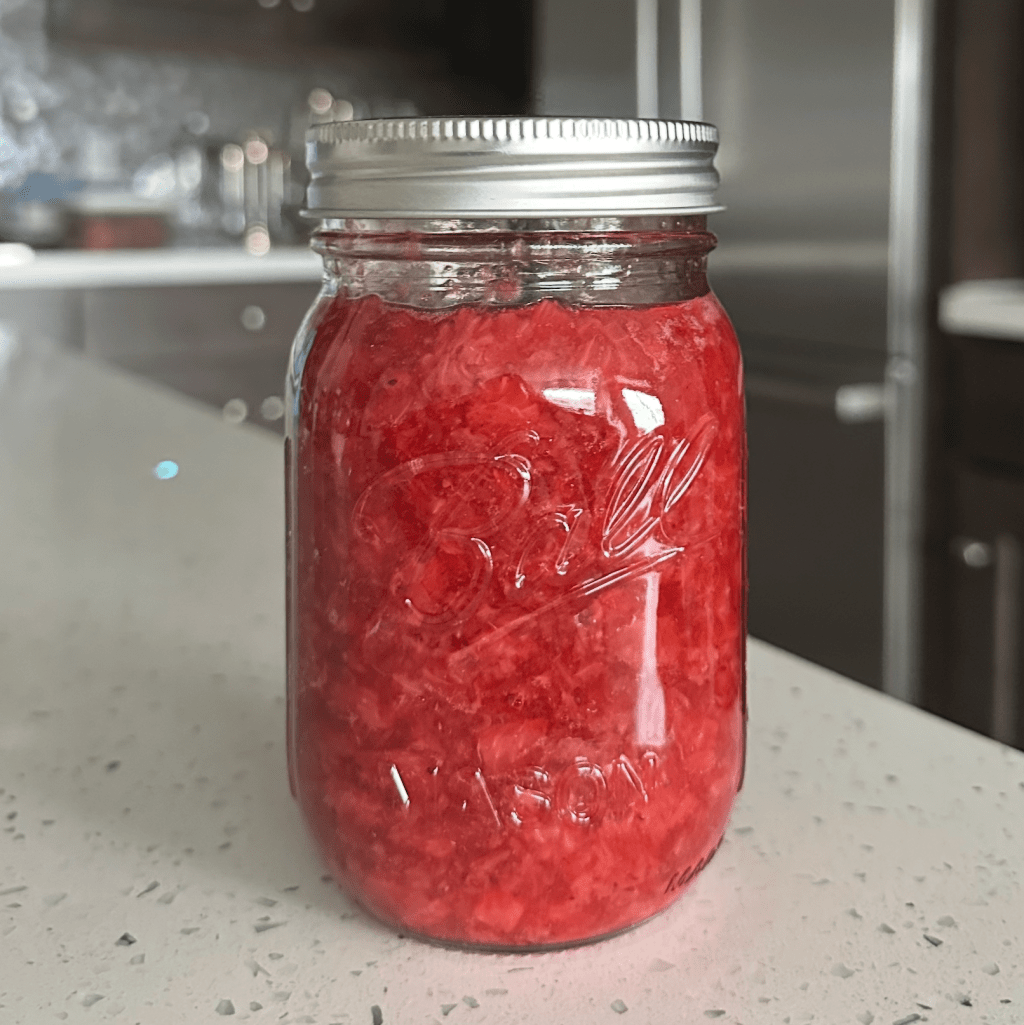
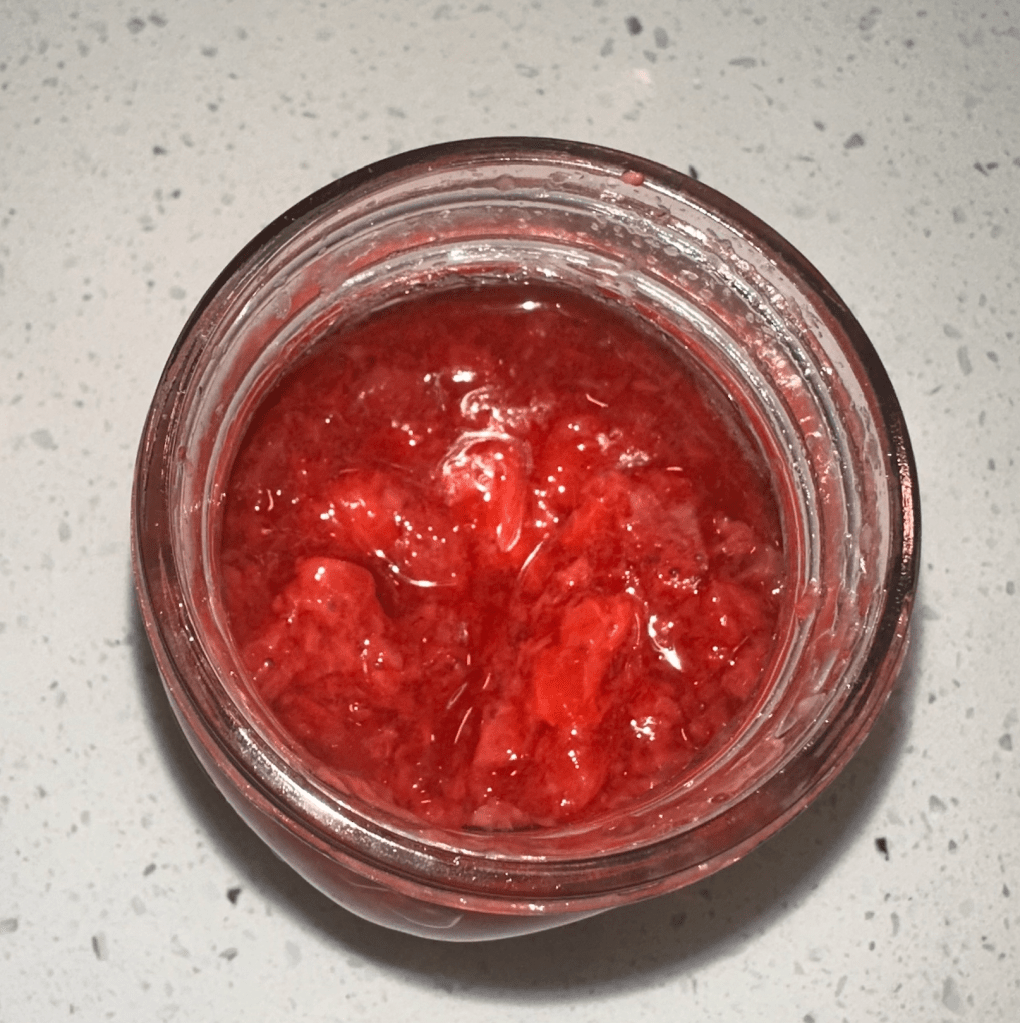
After trying the Smuckers Sugar Free Strawberry Jam and wondering if I lost my sense of taste, I decided to make strawberry jam at home. My options were either eat 1300 calorie jam, have jam that doesn’t taste like anything, or just make it myself. Well, I made it myself with four ingredients: strawberries, lemon juice that I squeezed, sugar, and a dash of salt. After doing basically no work, I got the most beautiful and tasty jar of jam. Minimal sugar added, and I can even choose to skip the sugar altogether and add pectin instead as a natural thickener.
Life is meant to be moderation and balance and a little bit of everything — even Red 40 when it calls for it. But if every one of your meals includes 60% of ingredients that came out of a factory, then your body includes it too. You want food to taste like food? You want to perform your best? You want to look and feel your best? Love this phrase:
“I’ve got food at home.”
PS: This is how red a homemade strawberry jam looks like without Red 40 (no editing on photos):
If strawberries are the second most abundant ingredient in their recipe, I wonder why they feel the need to add the Red 40…

 The Health Is Wealth Files
Leave a comment